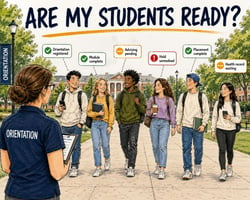
Maybe the checklist was never really about checking boxes.
I’ve spent years watching orientation professionals use task lists to help students navigate much more than a list of things to complete.
What applies to this student?
What needs to happen first?
What are they still waiting on?
What can’t happen until something else is finished?
What needs to happen before orientation?
And what still matters afterward?
The more we learned from institutions, the more we started to see what was underneath all those tasks.
The journey.
Students don’t experience an organizational chart
A student doesn’t experience financial aid, advising, orientation, health requirements, registration, housing, and everything else as an organizational chart.
They experience what applies to them.
What they’ve done.
What they’re waiting on.
And what comes next.
That sounds simple, but it changed the way we thought about the student experience.
Because the institution may see separate offices, systems, requirements, and responsibilities.
The student experiences one evolving journey through them.
Every institution puts that journey together differently
Different requirements.
Different priorities.
Different systems.
Different sequences.
Different understandings of what students need to be prepared for what comes next.
That’s something orientation professionals have taught us repeatedly over the years.
There isn’t one journey that every institution should follow.
The work is understanding how each institution has designed its own experience and how all of those responsibilities come together for the student moving through it.
We didn’t abandon the checklist
We learned what was underneath it.
By 2021, that learning had already started changing how we thought about the experience of each participant.
At VisualZen, we called that idea Path.
Not because we had discovered one journey every institution should follow.
Quite the opposite.
The institution sees many responsibilities.
The student experiences one evolving journey.
Path was one expression of something we had begun to understand differently through our work with orientation professionals.
And we’ve kept learning from what happens along that journey ever since.
We still learn this way
This is still how we learn at VisualZen.
We spend time understanding how orientation actually works at different institutions.
What the institution needs students to do.
Which responsibilities belong to which people and systems.
How those responsibilities connect.
And how students actually experience the journey that results.
Then we use what we learn to help technology better support the people and processes behind it.
Because sometimes a simple checklist can teach you something much larger about the experience you’re trying to support.