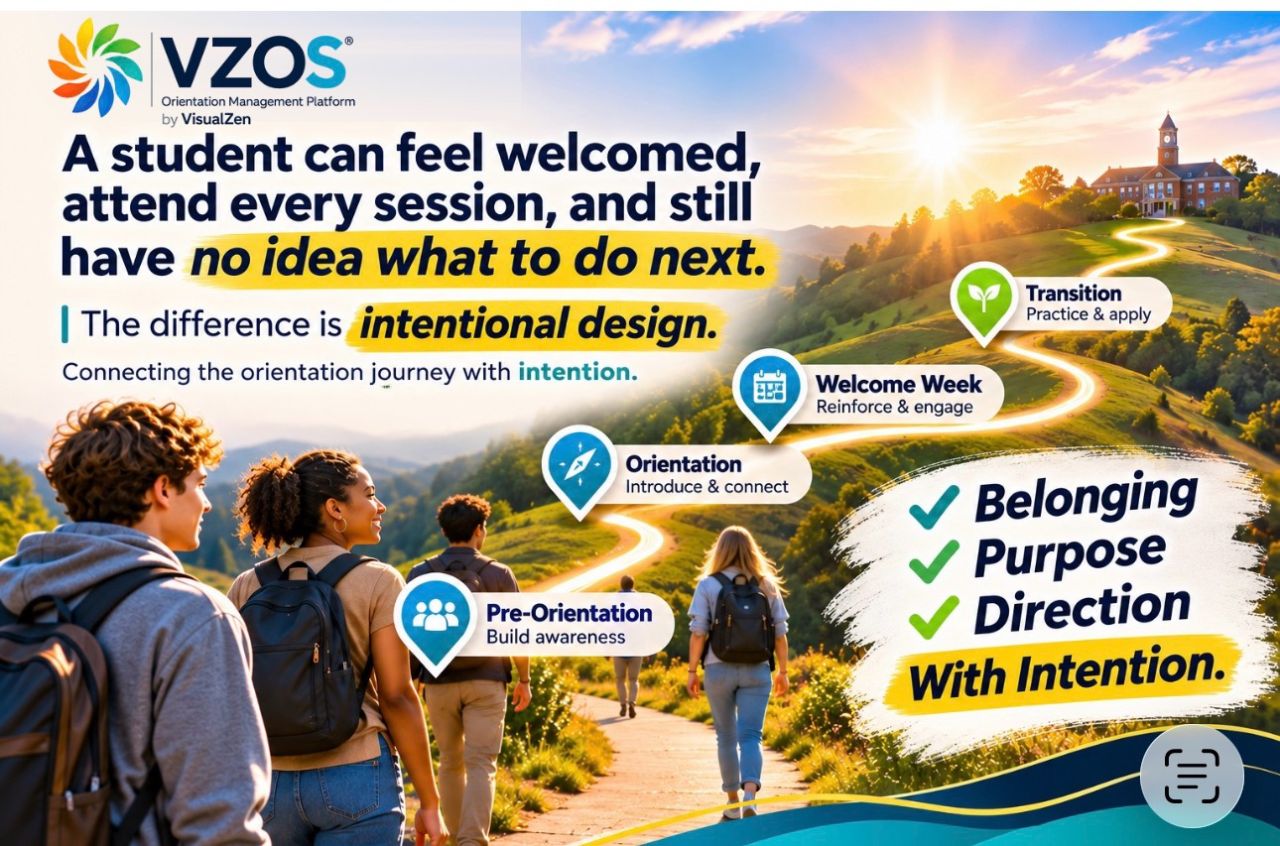
A closer look at how institutions can connect learning across orientation, Welcome Week, and the student onboarding journey.
A student can attend every orientation session, meet new friends, connect with an orientation leader, and leave feeling genuinely excited about college.
That's a pretty good outcome.
But here's something I've been thinking about lately.
What did that student actually learn?
And perhaps more importantly, will they know how to use what they learned when they need it?
I've been exploring curriculum mapping and how it might help orientation professionals answer those questions.
It's not a new concept in higher education. But when we apply it to the broader student onboarding journey, some interesting possibilities emerge.
What Is Curriculum Mapping in College Orientation?
Curriculum mapping connects intended learning outcomes with the experiences where that learning takes place.
In college orientation, it means identifying what incoming students should learn, where those opportunities occur across orientation and onboarding, and how that learning is introduced, reinforced, practiced, or assessed.
Academic programs have used curriculum mapping for years to understand how students develop knowledge and skills across courses.
But orientation is an educational experience, too.
Students are learning how to navigate academic expectations, access campus resources, build relationships, make decisions, and take responsibility for their college experience.
And that learning rarely happens in one place.
It might begin during pre-orientation, continue through summer orientation, develop during Welcome Week, and carry into the first semester.
Curriculum mapping gives institutions a way to see how those experiences connect.
In fact, NODA's professional competencies recognize curriculum development and the importance of connecting programs to broader student learning goals.
So the idea isn't foreign to orientation. It's already part of how our profession thinks about student learning.
The Student Experiences One Journey
One of the things I've learned from working with orientation professionals over the years is just how differently institutions organize the transition into college.
Some orientation offices oversee everything from pre-orientation through Welcome Week.
Others focus primarily on summer programming.
Academic advising, housing, first-year experience, student affairs, and individual academic colleges may each own different parts of the journey.
And that's perfectly reasonable.
Institutions have different structures, resources, and priorities.
But students don't necessarily experience those organizational boundaries.
To them, it's all part of becoming a college student.
Think about a student who completes an online orientation module in May, attends summer orientation in June, participates in Welcome Week in August, and begins a first-year seminar in September.
Each experience may be planned by a different team.
Each may have its own objectives.
But how intentionally are those objectives connected?
One department might assume students already learned something during orientation.
Another might be planning to introduce the same information during Welcome Week.
A third might expect students to arrive knowing how to complete a particular task.
Everyone is doing their part.
But has anyone looked at how those parts contribute to the student's learning?
That's one of the opportunities curriculum mapping presents.
Are We Repeating Information or Reinforcing Learning?
Orientation professionals face an enormous challenge.
There is so much students need to know, and often very little time to cover it.
Academic expectations. Campus resources. Personal responsibility. Safety. Belonging. Involvement. Advising. Financial matters.
The list goes on.
And repetition isn't necessarily a bad thing.
Students may benefit from encountering important information more than once, particularly when they're navigating an unfamiliar environment.
But there's a difference between repeating information and intentionally reinforcing learning.
Consider academic advising.
During pre-orientation, students might learn what academic advising is and why it matters.
During summer orientation, they might meet with an advisor, discuss academic goals, and register for classes.
During Welcome Week, they might learn how to schedule future appointments or find advising support.
And during the first semester, they may apply that knowledge when making academic decisions.
Those experiences are related, but they aren't identical.
Each can build on what came before.
Now imagine looking at those experiences together and asking whether they were intentionally designed to reinforce one another.
That's the value of a curriculum map.
It helps institutions distinguish between delivering the same information multiple times and developing learning across multiple experiences.
What Might an Orientation Curriculum Map Look Like?
It doesn't have to be complicated.
Imagine an institution identifies this learning outcome:
Students will be able to identify and access academic support when they need assistance.
Now consider how that outcome might develop across the student onboarding journey.
| Learning Stage | Student Experience | Intended Learning |
|---|---|---|
| Introduce | Pre-orientation module | Discover available academic support resources and understand their purpose. |
| Reinforce | Summer orientation | Learn when and why students might use those resources. |
| Practice | Welcome Week or first-year seminar | Locate a resource, explore appointment scheduling, or work through a help-seeking scenario. |
| Assess | First-semester activity | Demonstrate how to identify an appropriate resource and request assistance. |
This is a simplified example, but it illustrates an important distinction.
We're not just asking whether students received information.
We're examining how they develop the knowledge and confidence to use it.
A curriculum map might reveal that an important topic is introduced but never reinforced.
It might show that several departments are delivering similar information without building on one another's work.
Or it might demonstrate that campus partners are already doing an excellent job of connecting learning experiences.
That's worth knowing, too.
And assessment doesn't necessarily mean another quiz.
Students might demonstrate understanding through a scenario, a practical activity, or explaining what they would do when faced with a particular situation.
The appropriate approach depends on the learning outcome and the institution.
Who Connects the Learning Across Campus?
Here's another question worth considering.
Who owns the curriculum map?
At some institutions, orientation and first-year experience operate within the same office.
At others, they're managed by different departments, sometimes in different divisions.
Academic advising, housing, student affairs, and individual colleges may each contribute to student learning without having responsibility for the entire journey.
And that's where curriculum mapping becomes as much about collaboration as curriculum.
Someone needs to help bring those experiences together.
That doesn't necessarily mean one department should control what everyone else teaches.
It means creating a shared understanding of what students are expected to learn and where that learning happens.
Of course, that takes time.
Campus partners have their own responsibilities, schedules, and priorities. Bringing everyone together to examine learning outcomes may not be easy.
But institutions don't necessarily need to map everything at once.
Starting with one important learning outcome and a few participating departments may reveal quite a bit.
Belonging Matters. So Does Knowing What Comes Next.
We put tremendous thought into helping students feel welcomed, connected, and part of their new campus community.
And we should.
The relationships students develop during orientation can be incredibly meaningful.
But I've been wondering whether we spend enough time connecting that sense of belonging with a sense of purpose and direction.
A student may feel welcomed and still be uncertain about how to navigate their first semester.
They may know where the tutoring center is but hesitate to ask for help.
They may have met an academic advisor but not understand when they should reach out again.
They may leave orientation excited about college without fully understanding what they need to do next.
That doesn't mean orientation failed.
It means student transition involves more than any single program can accomplish.
Curriculum mapping offers one way to examine how learning continues beyond the initial welcome.
It can help institutions ask not only whether students encountered important information, but whether the experiences they designed are preparing students to use it.
Sometimes the Opportunity Is to Connect What's Already There
I recently had a conversation with an orientation professional that brought this topic into sharper focus for me.
We were talking about the many responsibilities involved in preparing and delivering orientation, and I asked a question I often enjoy asking.
If you could free up some of your time, what would you spend more time doing?
The answer was curriculum mapping.
Not because the institution lacked a strong orientation program.
Quite the opposite.
The interest was in being able to see and demonstrate where students were learning particular things across multiple programs.
If university leadership or a campus partner asked whether students were learning something, the team wanted to be able to show where it was introduced, how frequently it appeared, and how those experiences connected.
I thought that was a fascinating answer.
Because it shifts the conversation from how many programs we're delivering to how intentionally those programs contribute to student learning.
And it raises another question.
How much of this learning is already happening, but simply hasn't been mapped?
Attendance Tells Us Something. Learning Tells Us Something Else.
We already measure a great deal about orientation.
Registrations. Attendance. Session participation. Completed requirements. Student evaluations.
Those measures are useful.
They help institutions understand how their programs operate, who participated, and whether certain requirements were completed.
But they don't necessarily tell us what students learned.
A student attending a session doesn't mean they understood everything presented.
Completing an online module doesn't automatically mean they can apply that information.
And a positive orientation evaluation doesn't necessarily tell us whether a student will know what to do when a challenge arises six weeks later.
Curriculum mapping doesn't answer those questions by itself.
What it can do is help institutions identify where learning is intended to happen and where meaningful assessment opportunities might exist.
That distinction matters.
Especially as we continue exploring the relationship between orientation, student readiness, onboarding, and persistence.
Curriculum mapping alone isn't going to solve retention challenges.
Relationships matter. Belonging matters. Academic and personal support matter.
But helping students develop practical knowledge and understand how to navigate challenges is relevant to their transition into college.
And understanding what we're teaching, where we're teaching it, and how students are expected to use it seems like a worthwhile place to begin.
What Could We Learn by Looking Across the Entire Journey?
I've spent a lot of years talking with orientation professionals about how they run their programs.
How students register.
How schedules are organized.
How orientation leaders are prepared.
How campus partners participate.
And how institutions manage everything that needs to happen before students begin classes.
Those conversations are always interesting because no two institutions approach the work exactly the same way.
But curriculum mapping has me thinking about another dimension of those conversations.
Not just what students experience.
What are we intentionally helping them learn across those experiences?
Maybe the opportunity isn't to add more sessions, create another checklist, or redesign an entire orientation program.
Maybe it's to look at what's already happening and make the connections clearer.
Because a student can feel welcomed, attend every session, and still be unsure what to do next.
And perhaps one of the most valuable things we can do is help connect the learning that gives students both a sense of belonging and a clearer sense of direction.
I'm curious how other orientation professionals are approaching this.
Have you developed a curriculum map for your orientation or onboarding programs? And if so, what did you discover when you started looking at learning across the entire journey?